Caroline County Dog Registration Information
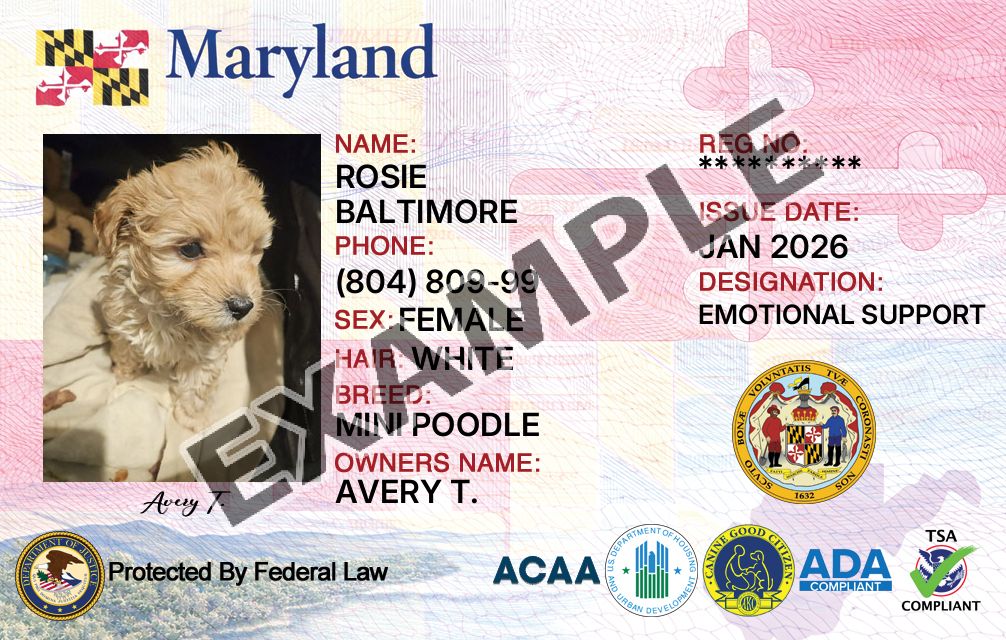
Service Dogs and Emotional Support Animals in Caroline, Maryland
If you’re asking where do I register my dog in Caroline County, Maryland for my service dog or emotional support dog, the answer usually involves two separate topics: (1) county dog licensing (a local requirement that may apply to most dogs, including many working service dogs), and (2) service dog or emotional support animal (ESA) status (legal definitions that are not created by a single “registration” database). This page explains where to register a dog in Caroline County, Maryland, what you typically need (especially rabies vaccination proof), and how licensing differs from service dog and ESA rules.
Important Clarification (Service Dogs & ESAs)
- Dog licensing is handled locally (Caroline County and, in some cases, incorporated towns) and is commonly tied to rabies vaccination.
- Service dogs are defined by training and task work for a disability under federal law; there is no universal federal government registry that you must use.
- Emotional support animals (ESAs) are not the same as service dogs and are mainly addressed in housing contexts; ESAs are generally not granted public-access rights like service dogs.
Where to Register or License Your Dog in Caroline County, Maryland
Caroline County’s animal welfare and control code indicates that dog licenses are sold through Caroline County Animal Control, the Caroline County Humane Society, Inc., the Caroline County Comptroller, and certain other designated locations (such as participating veterinarians). The offices below are the most relevant official contacts serving residents who need an animal control dog license in Caroline County, Maryland. (ecode360.com)
Official Offices Serving Caroline County Residents
| Office | Address | Phone | Hours | |
|---|---|---|---|---|
| Caroline County Comptroller (Courthouse) |
109 Market Street, Room 133 P.O. Box 459 Denton, MD 21629 |
(410) 479-0410 | cmoore@carolinemd.org | Not verified (contact office to confirm) |
| Caroline County Humane Society, Inc. |
407 W Bell Street Ridgely, MD 21660 |
(410) 820-1600 | info@carolinehumane.org | Not verified (contact office to confirm) |
Overview of Dog Licensing in Caroline County, Maryland
What “dog registration” usually means locally
In Caroline County, when people say “register my dog,” they are commonly referring to getting a dog license in Caroline County, Maryland. A dog license is a local government record that helps identify animals, supports animal control services, and commonly confirms that the dog has a current rabies vaccination on file.
Rabies vaccination proof is typically required before a license is issued
Caroline County’s animal welfare and control code states that before any license is issued, the owner must produce a valid rabies certificate issued by a licensed veterinarian showing the dog is currently vaccinated. (ecode360.com)
Service dogs may still need a county license (but fees can differ)
Caroline County’s code includes an exemption from the annual licensing fee for certain certified assistance dogs while still requiring the owner to obtain a county dog license (and typically display it, with limited exceptions). If you have a service dog, ask the licensing office what documentation they accept for any fee exemption and what tag/display rules apply. (ecode360.com)
Do rules differ by town within Caroline County?
Some incorporated towns can have additional ordinances or processes. If you live inside an incorporated municipality (for example, within town limits), it’s smart to confirm whether the town has any additional pet licensing rules. If you’re unsure, start with the county licensing contacts listed above and ask whether your address falls under any municipal requirements.
What You Need Before Registering a Dog
Core documents and details to gather
Requirements can vary depending on where you purchase the license (county office, humane society, or other authorized locations). In general, you should be prepared with:
- Current rabies vaccination certificate from a licensed veterinarian (often required to issue the license) (ecode360.com)
- Owner identification (helpful for counter service or mail-in processing)
- Your current address in Caroline County, Maryland (for residency and mailing purposes)
- Dog details: name, breed/description, age, color/markings, sex
- Spay/neuter information (some jurisdictions set different fees based on sterilization status)
- Service-dog related documentation (only if asking about any exemption or special handling at the licensing counter; requirements can be office-specific)
If your dog is a service dog or emotional support dog
For county licensing, the key factor is typically still rabies vaccination status and meeting local dog licensing requirements. Service dog status and ESA status usually matter for access or housing rules, not for replacing local licensing. If you’re unsure what to bring, call ahead and ask what they require for (a) a standard license and (b) any service-dog-related fee exemption that may apply under local rules.
Steps to Register or License a Dog in Caroline County, Maryland
Step-by-step process
- Confirm you have a current rabies certificate. Caroline County licensing requires proof of current rabies vaccination before a license can be issued. (ecode360.com)
- Choose the best official place to buy the license. County code indicates licenses may be sold through Caroline County Animal Control, the Caroline County Humane Society, Inc., the Caroline County Comptroller, certain veterinarians in Caroline County, and other designated locations. (ecode360.com)
- Bring your documents and dog details. Have your rabies certificate, ID, and dog details ready to reduce delays.
- Ask about applicable fees and any exemptions. If your dog is a trained service dog, ask whether an annual fee exemption applies under local rules and what documentation is needed. (ecode360.com)
- Receive your license record and tag (if issued). Keep the paperwork in a safe place and follow any tag display requirements provided by the issuing office.
Quick comparison: license vs. service dog vs. emotional support animal
| Category | What it is | Who issues/recognizes it | Common requirements | What it does (and does not) do |
|---|---|---|---|---|
| Dog License (Caroline County) | Local licensing/registration for dogs kept in the county. | Local agencies/authorized sellers serving Caroline County (such as the county comptroller and humane society listed above, plus other authorized locations). | Typically requires proof of current rabies vaccination before issuance. (ecode360.com) | Helps document ownership and vaccination compliance; supports animal services. It is not a “service dog certification.” |
| Service Dog | A dog individually trained to do work or perform tasks for a person with a disability. | Recognized by federal law based on training and function; not created by a single registry. | Task training related to a disability; handler responsibilities; local licensing may still apply. | Can provide public access rights in many settings where pets are not allowed (with limited exceptions). It does not replace local dog licensing. |
| Emotional Support Animal (ESA) | An animal that provides comfort by its presence and supports a disability-related need (commonly in housing contexts). | Typically documented through a healthcare provider’s disability-related recommendation for housing; not created by a federal registry. | Disability-related need; housing documentation as requested/allowed by law. | May support reasonable accommodations in housing, but generally does not provide the same public access rights as a service dog. |
Service Dog Laws in Caroline County, Maryland
Service dog status is not created by a county dog license
A county dog license is a local licensing record. A service dog’s legal status comes from the dog being trained to perform disability-related tasks and from the handler’s rights and responsibilities under applicable laws. Even if you have a service dog, you may still be expected to follow dog licensing requirements in Caroline County, Maryland (including rabies documentation), while also potentially qualifying for fee exemptions under local rules. (ecode360.com)
Local licensing and possible fee exemptions
Caroline County’s animal welfare and control code describes that certain assistance dogs may be exempt from paying an annual licensing fee, but still must obtain a county dog license. Because documentation standards can vary by office, it’s best to call the licensing locations in the office section and ask what they require for any fee exemption and what the issuance process is for your situation. (ecode360.com)
Emotional Support Animal Rules in Caroline County, Maryland
An ESA is not the same as a service dog
An emotional support dog (ESA) provides comfort and support, but it is not necessarily trained to perform specific tasks related to a disability in the same way a service dog is. For most public places, ESAs are generally treated as pets under access rules, even if they provide important disability-related support.
Local dog licensing still matters for ESAs
Having an ESA does not usually replace or override local licensing requirements. If you keep a dog in Caroline County, you should still plan to meet the county’s dog licensing rules, including providing proof of current rabies vaccination before a license can be issued. (ecode360.com)
Frequently Asked Questions
Register A Dog In Other Maryland Counties
Select your county below to get started with your dog’s ID card. Requirements and license designs may vary by county, so choose your location to see the correct options and complete your pup’s registration.
- Allegany County Dog Registration
- Anne Arundel County Dog Registration
- Calvert County Dog Registration
- Carroll County Dog Registration
- Cecil County Dog Registration
- Charles County Dog Registration
- Dorchester County Dog Registration
- Frederick County Dog Registration
- Garrett County Dog Registration
- Harford County Dog Registration
- Howard County Dog Registration
- Kent County Dog Registration
- Montgomery County Dog Registration
- Prince George’s County Dog Registration
- Queen Anne’s County Dog Registration
- Somerset County Dog Registration
- St. Mary’s County Dog Registration
- Talbot County Dog Registration
- Washington County Dog Registration
- Wicomico County Dog Registration
- Worcester County Dog Registration